

August 3rd, 16th, 30 – Pelagic Birds And Mammals
TOWNSEND'S STORM-PETRELS, plus Cook's Petrels, incredible temperature break loaded with phalaropes, shearwaters, Arctic Terns, and a Manx Shearwater
First-cycle(!) Hawaiian Petrel, South Polar Skua, banded Black-footed Albatross from Midway all on a half-day trip.
Vocalizing Nazca Booby circles boat for 10 minutes; another Hawaiian Petrel; record numbers of Black Storm-Petrels plus Wilson's and Least.
Join us for our next trip on September 27, 2026

These were three variable trips, all quite productive thanks to Richard Thornton and Anchor Charters, along with our trusty deckhands Dan and Mason; see the bottom of our June 26th report for our salute to them for their hard work chopping fish and squid, fixing up our menhaden oil drip, and helping us at chum stops, as they do every trip. Twenty-five to 35 participants joined us on each trip. Noyo Canyon was busy as always, with 1000s of shearwaters, dozens of albatross, Red and Red-necked Phalaropes, all four jaeger/skuas, various terns, and Sabine’s Gulls moving south on all four trips. Although the focus was birds, we also noted many Humpback Whales and several Blue Whales and Fin Whales on one or more of these trips.
The trip of August 3rd was rather ideal for pelagic seabirding, calm inshore with a shear of windier weather offshore. As we got into the wind, Cook’s Petrels began coming into our slicks, 9-10 in all, a marquee bird of the summer up and down the coast. Richard pulled up his Terrafin app and we also noted an abrupt temperature break about 25 miles out, 55-57 F degree water to the east and 61-63 degrees to the west. When we got to the break it was marked by a distinct slick line full of birds. Not only this, but it was windy with whitecaps on the eastern side and calm on the west side! None of us had seen this before. We decided to work the break and had 100s of phalaropes, dozens of shearwaters and storm-petrels, and a flock of 60 Arctic Terns and 10 Sabine’s Gulls feeding over bait fish. A Manx Shearwater was in with a flock of Sooties, sitting and feeding along with the Arctic Terns and, later, a Flesh-footed Shearwater was also found among photos.


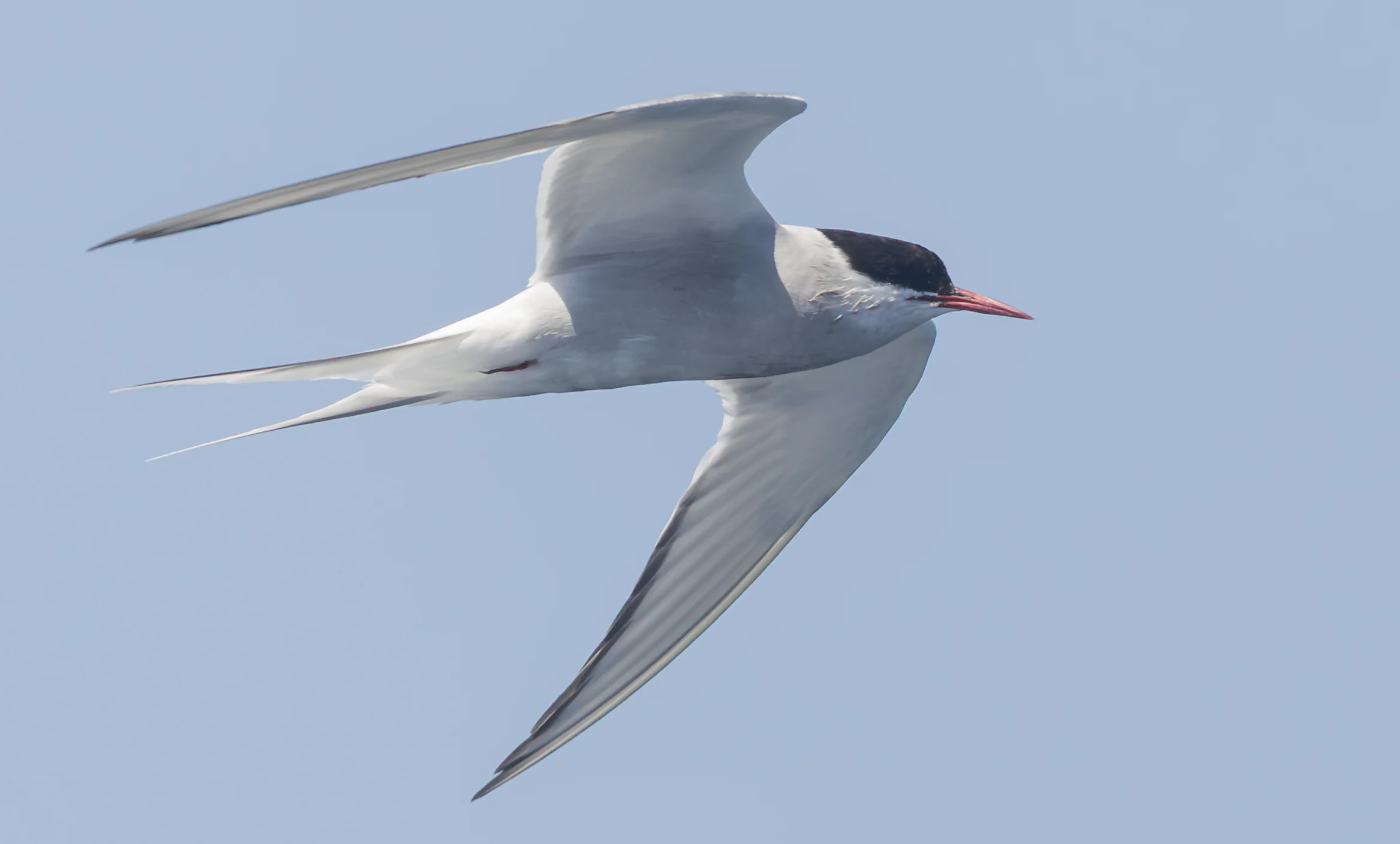

Cook’s Petrel, Sabine’s Gull, Arctic Tern, Manx Shearwater. Photos: Stephen Davies (petrel, shearwater) and Roger Adamson.
Storm-petrels again provided variety, with 35 Ashies, 4 Fork-tailed, 2 Wilson’s and 60 Leach’s tallied. Leach’s tends to be found further offshore than the others; we have good luck with these off Noyo in summer since we are so far out there to begin with (90 miles longitudinally west of SF). The big score was being able to document 6 Townsend’s Storm-Petrels as well. This species breeds on Guadalupe Island, Mexico, was split from Leach’s about 15 years ago, is smaller and darker than the Leach’s, with a more distinct white uppertail-covert band and less of a tail fork, and it flies noticeably differently, with less bounding than Leach’s. For a full recap of this issue see the eBird checklists, for example, here. Based on these birds we felt comfortable also accepting one Townsend’s Storm-Petrel from last year on our trip of July 15th (see report here).


Wilson’s Storm-Petrel (note feet beyond tail), Leach’s Storm-Petrel, and two Townsend’s Storm-Petrels (bottom). Photos: Roger Adamson and Tim Bray.
The trip of August 16th, an afternoon half-day outing, was arranged by the Pacific Union College as part of a 4-day field trip to the Albion Field Station (this group also spotted a Black Skimmer at the Navarro River mouth the day before). Very light breeze with slight fog made for an easy ride. We encountered the first Black-footed Albatrosses just beyond the outer buoy, one of which was banded and later found to be from Midway Atoll. We tried an oil-slick chum site, which attracted a few Ashy Storm-Petrels. Shortly after leaving the slick we spotted a Hawaiian Petrel that made a couple of very close passes. A life bird for several of those on board! The Hawaiian Petrel proved to be a worn first-year bird, rarely photographed at sea. You can age these by the uniformly narrow, worn, and brown juvenile flight feathers, grown in the nest. Not only that, it was in “formative plumage” having replaced some back feathers with grayer formative feathers. This confirms that this plumage exists in Hawaiian Petrel. The additional highlight was a South Polar Skua that came to and followed the boat for several minutes, giving great views.


Banded Black-footed Albatross, first-year Hawaiian Petrel, South Polar Skua. Photos: Tim Bray and Roger Adamson.
On August 30th we again had calm winds (but bumpy seas) inshore and a wind shear offshore, again this weather resulted in quantity and quality of seabirds, and highlights again included storm-petrels, this time 34 Blacks (tripling the previous all-time total for Mendocino County waters!), 27 Ashies, 2 Fork-tailed, a Wilson’s, and a Least. Several Cook’s Petrels were seen at distance and a Hawaiian Petrel came into one of our slicks, sallying about for several minutes for all to enjoy. The highlight for many came at our third slick, when a near-adult Nazca Booby (it had a few dark flecks remaining on the rump) came in to check out the fray, and circled the boat against clear skies for about 10 minutes (most boobies are just fly-bys so this was a treat). It was calling frequently, a soft ‘kairk’ call which became more strident when a smaller Pomarine Jaeger started harassing it (those jaegers!). Cook’s Petrel, Least Storm-Petrel, and/or Nazca Booby, were county ticks for the Mendo long-time guard, most of whom were aboard.


Black Storm-Petrel, Hawaiian Petrel, Nazca Booby, Pomarine Jaeger chasing Nazca. Photos: Tim Bray, Roger Adamson, Peter Pyle.
We had dedicated this trip to our Mendo coast birding comrade, Lisa Walker, who we lost to cancer on the 28th. None of us are particularly religious, but we could not help but consider that the circling Nazca Booby, heading up into the blue heavens, was Lisa, at least in spirit, making our trip a success and saying a very fitting good bye.
Peter, Tim, and Roger
We greatly thank Caitlin Chock and Eric Heisey for keeping the eBird checklists and providing nice write up in the trip reports.